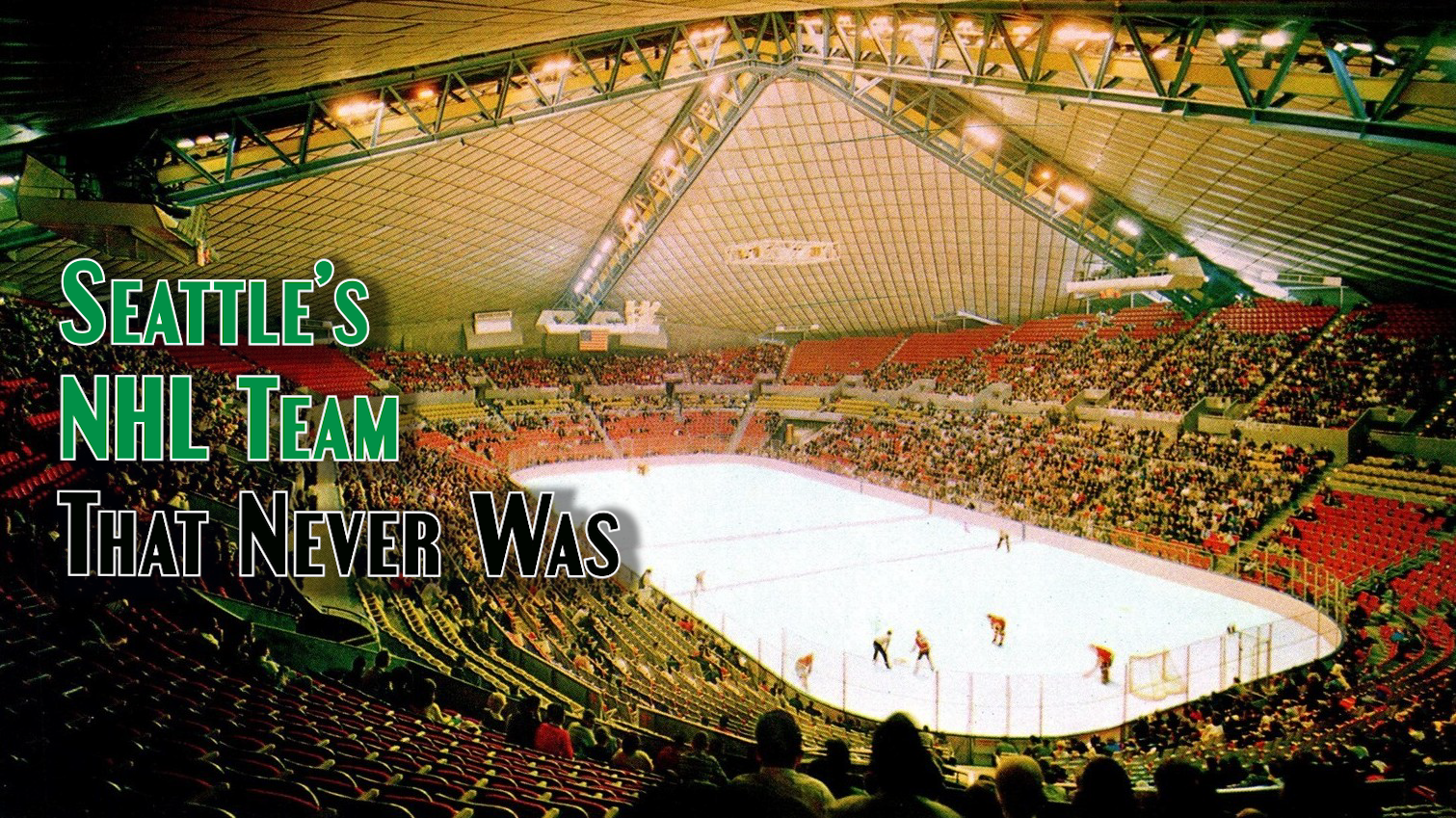

Kraken Almost-Ancestors
A half-century before the Seattle Kraken brought the National Hockey League here, Seattle was promised an NHL expansion team. Or the transfer of an existing NHL team. Or a World Hockey Association team.
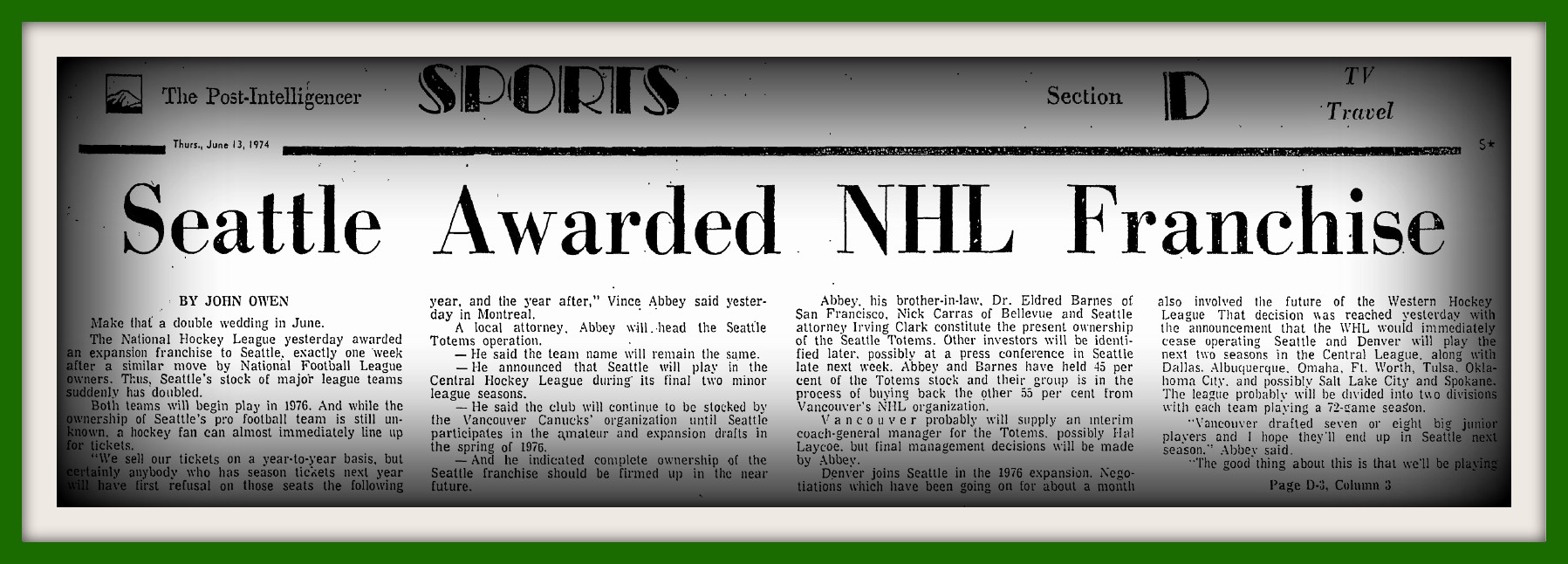
Of course, none of those happened. How it all fell apart is a fascinating mid-1970s tale of broken promises, missed payments, egos, lawsuits and backroom maneuvering. This is the last of five stories retrieved from the dusty archives of the Seattle Times (ST) and Seattle Post-Intelligencer (P-I).
July, 1975: WHA Sniffs Opportunity
“‘I don’t think the NHL wants to come to Seattle,'” said Bud Poile, WHA director of operations. ‘We’ve been interested in Seattle, and now I think Seattle is interested in us.’ Jack Fearey, Seattle Center director, and Poile huddled for an hour this morning. Questioned about the possibility of a team for this coming season, he cautioned, ‘Logistically it is next to impossible.'” (ST 7-30-75)

August, 1975
“William Jennings, head of the expansion committee, indicated the door is not totally closed to a new Seattle group (of investors). ‘I would not be surprised if Seattle wanted to get back in for 1976-77.'” (ST)
October, 1975
“Bill Hughes, owner of the Vancouver Canucks, after the Seals’ home opener attracted fewer than 4,000 fans. “Oakland is a good hockey club, but Oakland is not a good hockey town. There is some doubt now whether a rink will be built in San Francisco. And there is no place for them to go but Seattle. Oakland just isn’t a hockey town; Seattle certainly is.” (ST)

February, 1976
Spurned former Totems owner Vince Abbey, in commenting on his own litigation vs. the NHL, noted a similar ongoing lawsuit against Major League Baseball over the relocation of the Seattle Pilots to Milwaukee in 1970.
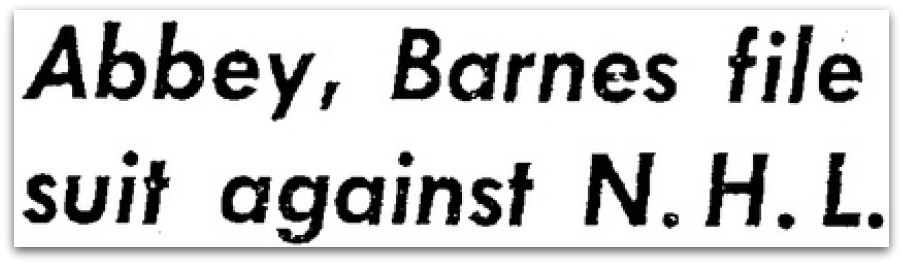
“Abbey expressed delight at the results of the baseball litigation. ‘I hope my suit does the same for hockey here. I sincerely believe it will. Both baseball and hockey will thrive here. It’s funny. They badmouth our town. Then they take a look at the attendance of the Sonics and Sounders and ticket sales by the Seahawks, and suddenly discover Seattle is one of the best sports cities in the country.'”
April, 1976
Columnist Hy Zimmerman: “Surprisingly, Clarence Campbell, NHL president, is said to be one of the most fervent in Seattle’s behalf. Campbell has been considered by Seattleites, this one included, most inimical* to our city’s NHL ambitions. Our well-informed informant insists Clarence truly wants us. Seattle, a pretty good hockey town. The NHL cannot say we did not warn them to come here before they committed themselves to the rigors of (1974 expansion twins) Kansas City and Washington.” (ST)
*I didn’t know what “inimical” means, either. It means “harmful, unfriendly, or hostile.”
Kansas City Scouts Did Relocate In 1976 – But Not Here
“Abe Pollin, owner of the Washington Caps, made inquiries here in the Scouts’ behalf. Abe, through an official of the Seattle Sonics, checked for interest in the Scouts by Cecil True of Gull Oil Co., once a potential backer of Vince Abbey. The interest apparently was tepid, so the Scouts are off to Denver.” (ST 8-22-76)
Something Else That Didn’t Happen
The NBA Sonics proposed to raise the Seattle Coliseum roof to enlarge capacity. Seattle Center director Jack Fearey thought that might rekindle the NHL’s attention. “We know there is a lot of interest in placing a franchise here. Being able to offer a building seating 21,000 would make Seattle very attractive for them.” (ST)
Pre-Kraken Epilogue
The roof wasn’t raised. The Penguins stayed put. The Seals moved to Cleveland, merging with the Minnesota North Stars and going out of business two years after that. Denver got the Scouts, then lost them to New Jersey after six miserable seasons.
The WHA never arrived in Seattle either, dissolving in debt in 1979 after seven seasons. Four of its member clubs (Edmonton Oilers, New England/Hartford Whalers, Quebec Nordiques, Winnipeg Jets) were accepted into the NHL under odious terms. A year later, the Atlanta Flames relocated to Calgary. After adding K.C. and D.C. in 1974, the NHL wouldn’t engage in a true expansion again until 1991, when the San Jose Sharks returned the league to California’s Bay Area.
Way back in 1977, Times columnist Zimmerman rued the whole years-long debacle that resembled nothing as much as Lucy ripping the football (or in this case, puck) away from Charlie Brown again and again and again.
“It is a jagged bone to the throat. Seattle still is overlooked by the National Hockey League. Here sits Seattle, which once played the Montreal Canadiens for the Stanley Cup, which drew more than 13,000 for a minor league hockey game, bereft of professional hockey.”
Seattle had another disastrous dalliance with NHL expansion in the 1990s – more like a case of self-sabotage – but that’s a story for another day.
In another ’77 column, Zimmerman made a prediction. “Hockey in Seattle is inevitable.”
And so it was, a mere 41 years later, when the Kraken were born in 2018.
Earlier Kraken:
— Kraken’s 2026 Relevance Put To The Test
— Big Time Kraken – NHL Talk With TV’s John Forslund
— Who The Heck Is … Ryden Evers

This series was rather interesting but a bit disjointed, as it merely quoted the Times and P.I. Glenn should write a summary that makes it more clear where the fault lay. Was it Abbey not being able to come up with funds or Jennings being duplicitous in not offering a franchise? It did not makes much sense back then, so 50 years on, we should be able to know who the good guy and who the villains were. Vince Abbey continued practicing law until 2014, so I would think he set the record straight somewhere. I remember his antitrust case but was not sure why he was not successful in it. C’mon Glenn, more of this.
Thank you for the feedback. Maybe we can talk the ‘professor’ into writing up a wrap up / opinion piece on the whole matter. Plus, he teased us with the 90’s reference / follow-up.
I looked at the anti-trust case, finally resolved in the federal court of appeals in 1986. That court agreed with the district court that Abbey had not met the conditions required for the conditional grant of an NHL franchise. There was no antitrust violation because doing so did not lessen competition in the Seattle sports market. By not granting Abbey a franchise, the competition in the market was actually increased, as now Seattle could acquire a WHA franchise. Abbey’s varied claims of the NHL’s monopoly denied Seattle an NHL franchise, a WHA franchise, and destroyed the WHL were all rejected. His agreements with the Canucks to repay his share of advances made to the Totems to allow it to continue operating were also held by the courts to be enforceable.
Reading these cases, one is left with the impression that either Abbey had either done a poor job of lawyering in the varied agreements he entered into, he did not truly have access to the funds required to acquire an NHL franchise, or the NHL was somehow playing fast and loose with him. Given his lack of legal success and his litigation approach (suing under anti-trust instead of just suing the NHL for violating their expansion agreement), it would seem the latter in unlikely as the main reason. His lack of success in the courts demonstrated less than stellar negotiating tactics in the agreements he was involved in, likely made worse by playing from a weak hand with a bankrupt minor league team in a failing league.
This leaves the lack of funding as the primary reason for his not being awarded a franchise. That is what should be uncovered, why did he pursue an NHL franchise without the necessary firm financial backing? Why did he not just turn to SeaFirst for funds, unless the poor mid-1970s economy restricted such an avenue? Did the NHL intentionally make it more difficult because it believed his financial support was weak? Or was there personal animus between Abbey and the NHL? I heard from my father back in the day that Abbey hoped to be awarded triple damages in his antitrust suit. It would be interesting to uncover why he could not secure funding? And why did Abbey not purchase a much cheaper WHA franchise instead? Will leave it to Glenn to uncover the truth.